7 Digital Marketing Strategies Every Business Should Use in 2026
The Nexa Solutions Team
4 min read
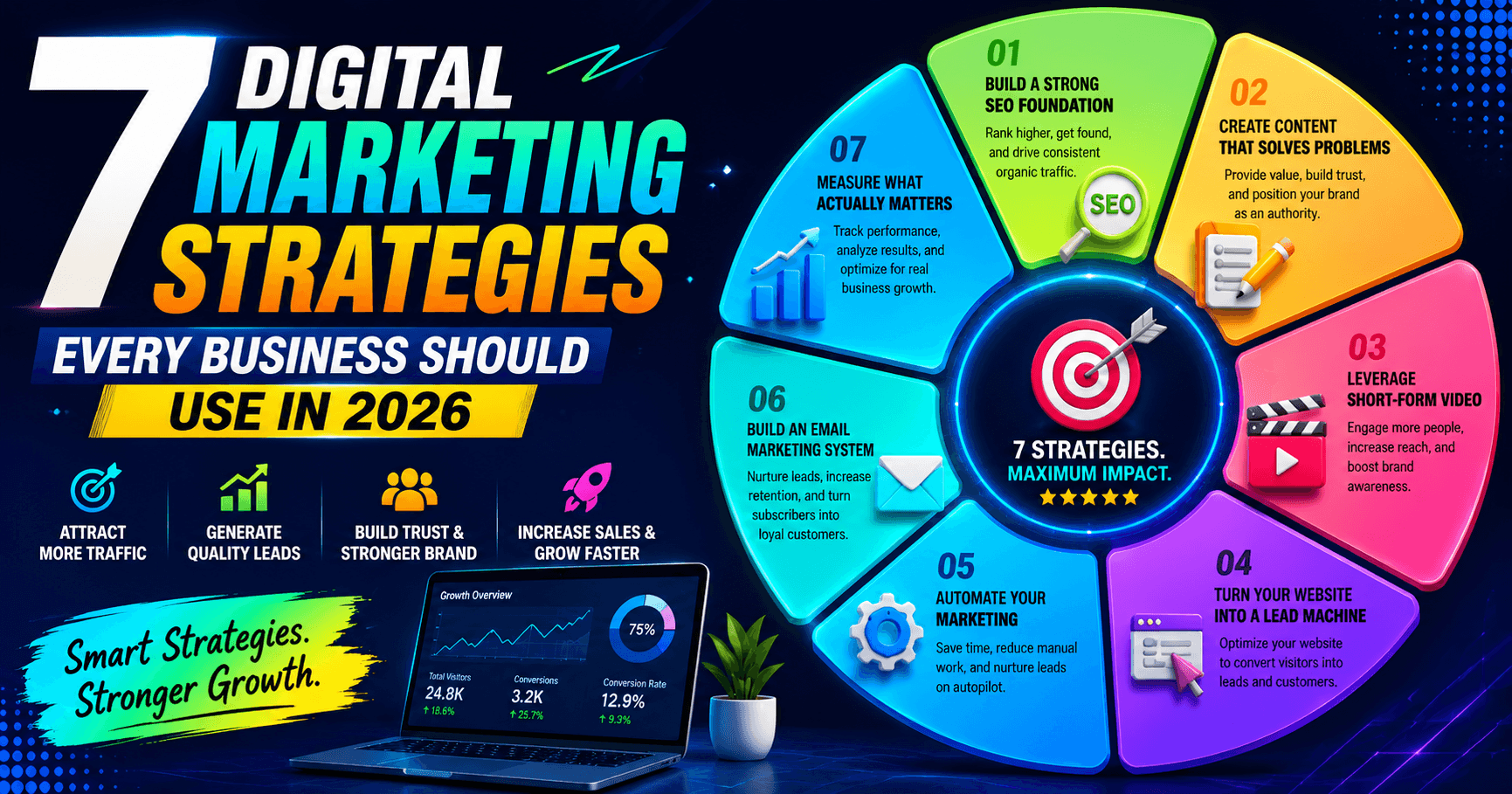
Table of Contents
7 Digital Marketing Strategies Every Business Should Use in 2026
Digital marketing is no longer simply about posting on social media or running advertisements.
Customers now interact with businesses across search engines, social media, websites, email, video, and AI-powered platforms.
That means businesses need a connected digital marketing strategy rather than relying on a single channel.
The good news?
You don't need to do everything at once.
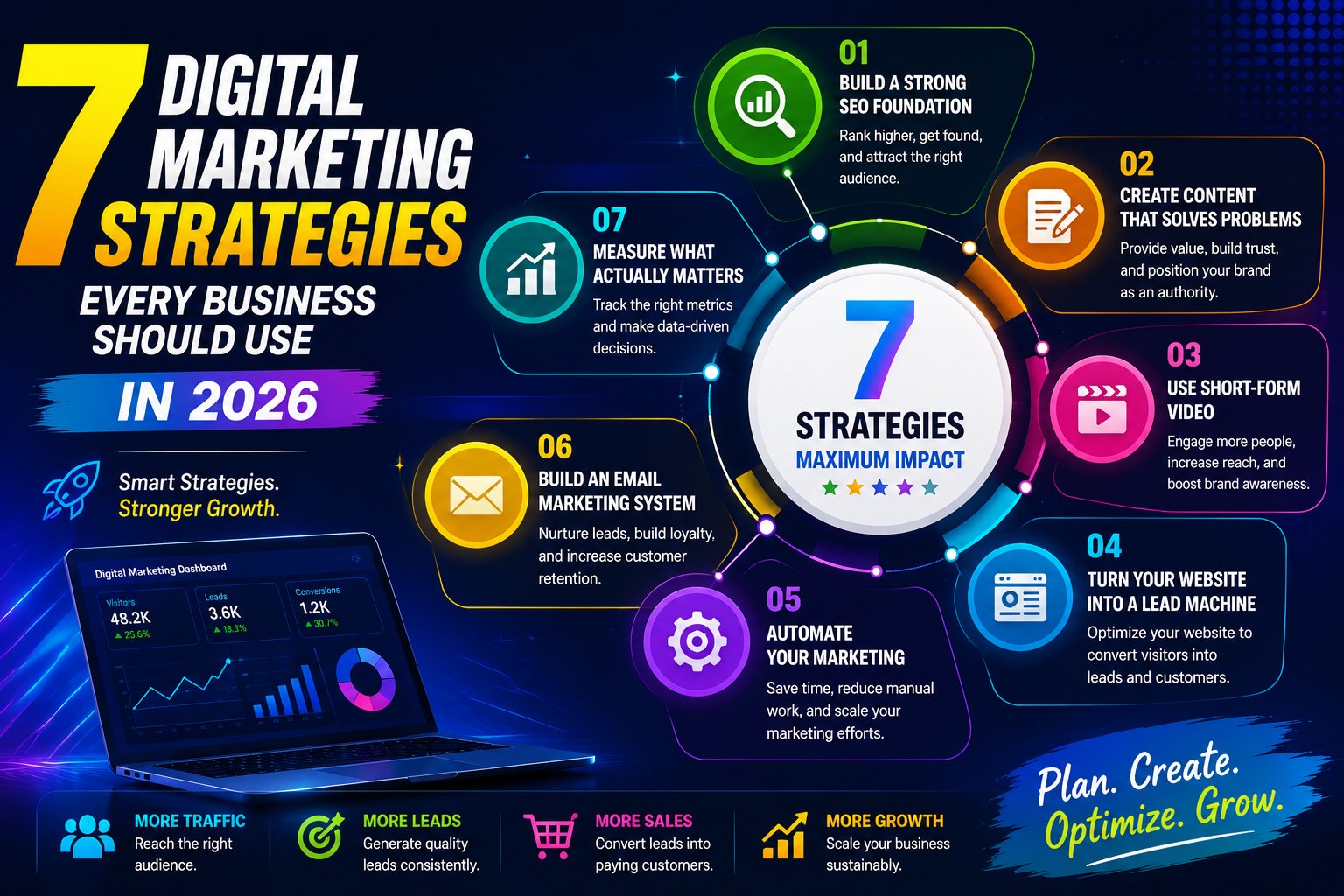
Here are seven digital marketing strategies that can help businesses attract attention, generate leads, and build sustainable growth in 2026.
1. Build a Strong SEO Foundation Search engines remain one of the most valuable sources of qualified traffic.
When someone searches for a product, service, or solution, appearing in the right search results can put your business in front of people who are already looking for what you offer.
A strong SEO strategy should include:
Keyword research
On-page optimization
Technical SEO
Internal linking
High-quality content
Local SEO
Backlink building
But SEO isn't about stuffing keywords into pages.
2. Create Content That Solves Problems
Content marketing works best when it provides genuine value.
Instead of constantly asking:
"What should we post today?"
Ask:
"What problems are our customers trying to solve?"
Those questions can become:
Blog articles
Videos
Instagram posts
LinkedIn posts
Guides
Case studies
Tutorials
FAQs
For example, a digital marketing agency could create content around:
"How to reduce your Google Ads cost"
instead of simply posting:
"We offer Google Ads services."
The first approach helps the audience.
The second simply promotes the business.
Educate first. Sell second.
3. Use Short-Form Video
Short-form video continues to be one of the most powerful ways to capture attention.
Platforms such as Instagram, YouTube, TikTok, and LinkedIn give businesses opportunities to reach audiences without relying entirely on paid advertising.
A single idea can become multiple pieces of content.
One topic can become:
Blog → LinkedIn Post → Instagram Reel → YouTube Short → Carousel → Email
This is called content repurposing.
Instead of creating everything from scratch, businesses can turn one strong idea into an entire content ecosystem.
4. Turn Your Website Into a Lead Generation Machine
Getting website traffic is only half the job.
The real question is:
What happens after someone visits your website?
Your website should make it easy for visitors to take the next step.
Depending on your business, that could be:
Requesting a quote
Booking a consultation
Starting a free trial
Downloading a guide
Contacting sales
Joining an email list
Purchasing a product
Your website should clearly communicate:
What you offer → Who you help → Why you're different → What the visitor should do next
A beautiful website that doesn't generate action isn't doing its full job.
5. Automate Your Marketing
This is where digital marketing and AI become extremely powerful.
Businesses can automate many repetitive marketing tasks.
For example:
New lead → CRM → Lead qualification → Personalized email → Follow-up → Sales notification
Other marketing processes that can be automated include:
-Email campaigns -Lead nurturing -Social media scheduling -Customer segmentation -Reporting -Review requests Lead notifications Content repurposing
Automation doesn't replace marketing strategy.
It gives your team more time to focus on strategy.
6. Build an Email Marketing System
Social media gives you reach.
Your email list gives you a direct communication channel with your audience.
A strong email strategy can include:
Welcome sequence
New subscriber → Welcome email → Educational content → Case study → Offer
Lead nurturing
New lead → Helpful content → Follow-up → Personalized offer
Customer retention
Purchase → Thank you → Product tips → Feedback → Cross-sell
Email marketing becomes much more powerful when it is connected to your website, CRM, and automation systems.
7. Measure What Actually Matters
Digital marketing produces a huge amount of data.
But more data doesn't automatically mean better decisions.
Businesses should focus on meaningful metrics such as:
- Cost per lead-Conversion rate-Customer acquisition cost-Return on ad spend-Website conversion rate-Organic traffic-Customer lifetime value
Don't just ask:
"How many people saw our post?"
Ask:
"Did this activity contribute to business growth?"
That's the difference between marketing activity and marketing performance.
The Future of Digital Marketing
Digital marketing is becoming increasingly connected.
SEO, content, social media, paid advertising, email, websites, analytics, and AI are no longer separate pieces.
They can work together as one system.
For example:
SEO attracts visitor
↓
Content builds trust
↓
Website captures lead
↓
AI qualifies lead
↓
Email nurtures lead
↓
Sales converts customer
↓
Automation supports retention
This creates a digital marketing engine that can continuously attract, engage, convert, and retain customers.
Final Thoughts
You don't need to implement every strategy immediately.
Start with the areas that can have the biggest impact on your business.
Improve your SEO.
Create useful content.
Build your audience.
Optimize your website.
Automate repetitive marketing tasks.
Measure the results.
Then improve the system over time.
Digital marketing isn't about being everywhere.It's about being where your customers are — with the right message, at the right time.
Build. Reach. Convert. Grow.
Ready to Automate Your Business?
Book a free strategy session and we'll show you exactly where automation could save your team the most time.
Frequently Asked Questions
Ready To Automate Your Business?
Book a free strategy session and we'll show you exactly where automation could save your team the most time.